Back to case studies

Dark Maze · Personal project · 2026

From one sketched screen to a playable game

Years ago I drew a single screen: a viking lost in a dark maze, seeing only what his torch lights. This year I turned it into a game you can play on your phone. AI did the building. The ideas, the connections between them and every decision about what stays came from me, one iteration at a time.

Play Dark Maze See how it evolved
RoleIdea, game and UX design, art direction, AI-directed production
Started fromOne sketched screen, no rules, no code
Built withClaude for code and game logic · Magnific for art, film, music and sound
Live atdarkmaze.branobajbar.sk

The starting point

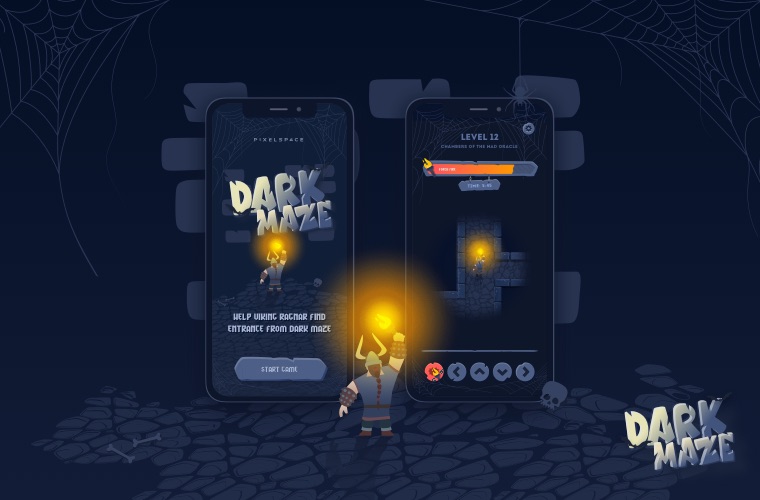
My original Dark Maze screen: a viking in a dark maze lit by his torch
The original screen. Everything else grew from here.

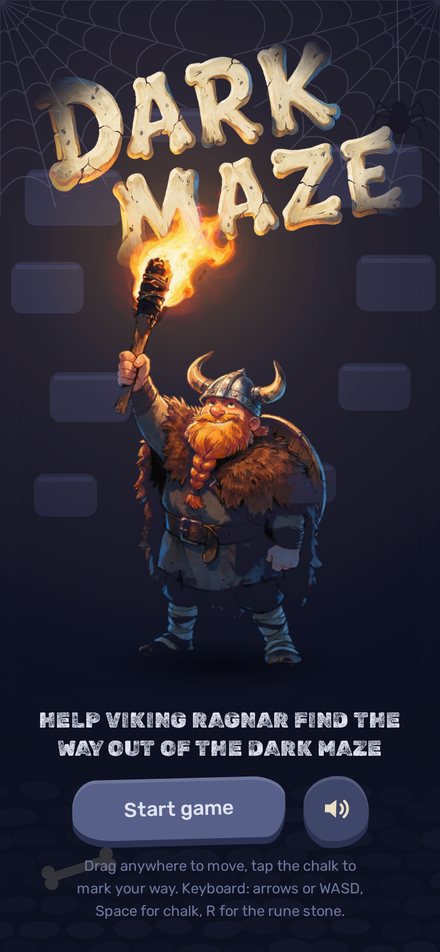
The sketch held the whole mood in one picture. Ragnar the viking in a dark maze. A circle of torchlight. Torches and oil that keep the light alive. Locked gates that need keys. Traps along the way.

What it didn't have was everything that makes a game work: rules, numbers, controls, balance, a reason to care and a reason to keep going. Turning one picture into a system is the part this case study is about.

How I worked

I worked with AI the way I work with a development team, only the loop was much shorter. I described a behaviour, the AI built it, I played it on my phone and decided what stays. Then the next idea. Every rule in the game went through this loop, most of them several times.

  1. MeSpot a problem or an idea
  2. MeDescribe the behaviour
  3. AIBuild it
  4. MePlay it on my phone
  5. MeKeep, change or throw away
“AI made development cheaper and faster.”

How the idea evolved

Each step started with a question about the player. Solving one usually raised the next.

01

Core mechanic

The light is the clock

The question. The sketch had torches and oil that keep the light alive. So what is the light really for, and what happens when it runs out?

What I decided. No timer on screen. The torch is the light, the timer and the life bar at once. A full torch burns for 60 seconds and the circle of light shrinks with it. Below 25 % it pulses and turns red. Oil adds 11 seconds, a new torch fills the flame back up.

Why it matters. One connection replaced three interface elements. It also made every later rule easy to read, because from now on everything in the maze either gives light or takes it.
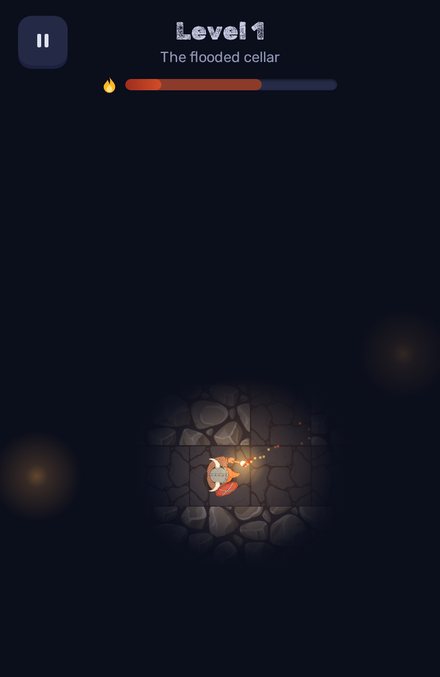
Ragnar with an almost burnt-out torch: a small circle of light and a red flame bar

02

Controls

One thumb is enough

The question. How do you move through a maze on a phone held in one hand, without covering half the screen with buttons?

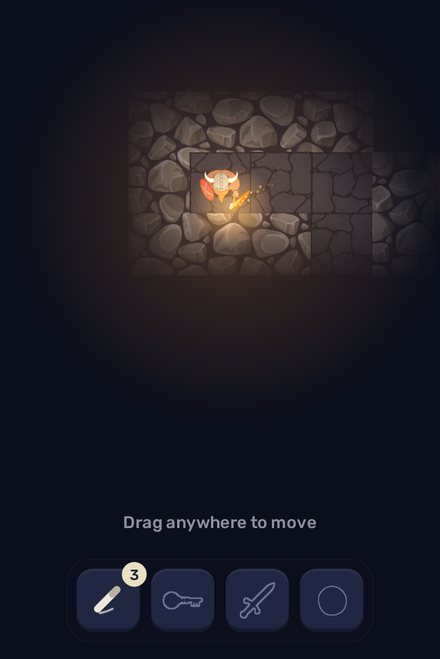
What I decided. Drag anywhere and an invisible joystick follows your thumb, with a small dead zone against accidental drift. Movement is smooth, not tile by tile. A quiet line says “Drag anywhere to move” only until the first touch. On desktop, arrows or WASD.

Start of a level with the hint Drag anywhere to move above the inventory

03

Exploration

Darkness forgets

The question. If everything you've already seen stays visible, the maze becomes a map within a minute. Where is the tension then?

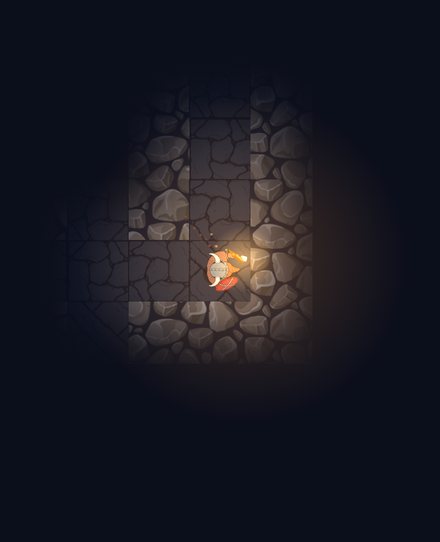
What I decided. Ragnar sees only what his torch lights and what walls don't block. Once he walks away, corridors fade back into darkness. No minimap, no arrows. You have to remember the way.

Ragnar in a corridor, the way behind him already fading into darkness

04

Guidance

Being lost needed an answer

The question. Removing the map created a new problem. A lost player stops having fun long before the torch dies. How do you help without taking away the feeling that they found the way themselves?

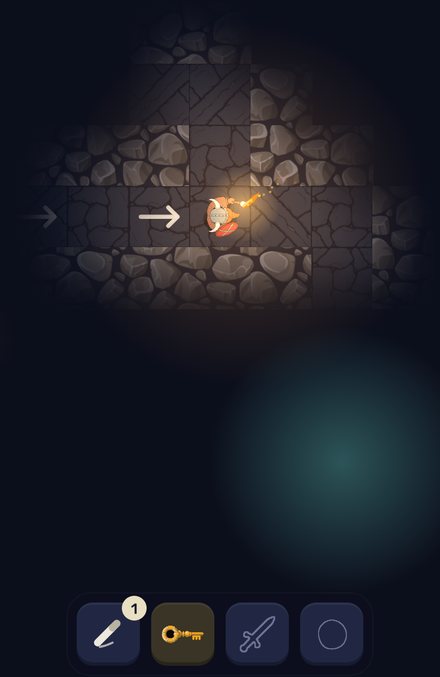
What I decided. The hint lives inside the world. Draft from the stairs bends the flame and its sparks towards the way out. The direction comes from real walking distance through the maze, so it never points into a wall. Near the exit a cold glow shows through the dark, and players get three chalk marks to draw arrows on the floor.

Chalk arrows on the floor, the key in the inventory and the cold glow of the exit nearby

05

Obstacles

Traps became decisions

The question. The sketch had traps. But a trap that only punishes feels like bad luck. Could it ask for a decision instead?

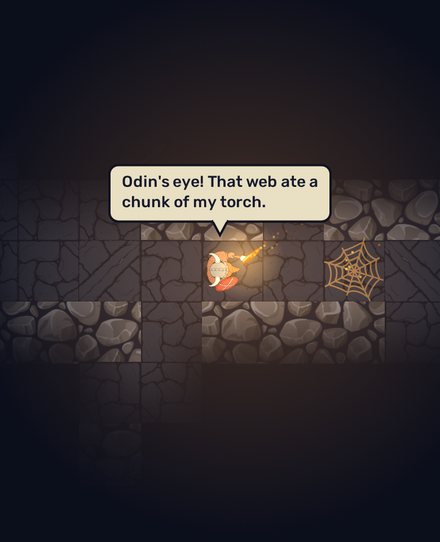
What I decided. Spider webs block the ideal route. Burning through one costs 5 seconds of flame. Each has a detour that costs no flame up front but takes longer, and in the dark you can't see how much longer. With a weak flame you can't burn at all. Puddles slow you down and make the torch burn four times faster. Now the light connects to every choice.

Ragnar burning through a spider web: Odin's eye! That web ate a chunk of my torch.

06

Character

A monster that talks first

The question. A maze needs a threat. How do you teach a rule without a tooltip, and without punishing a player who didn't know it yet?

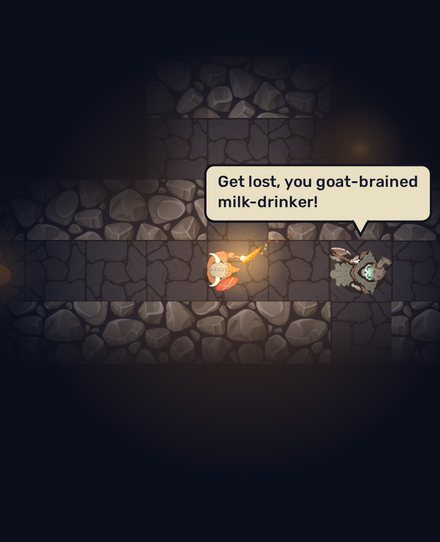
What I decided. A draugr blocks one corridor, never the only way to the key or the gate, and a sword is always within reach. Bump into it unarmed and it first insults you, then louder, and only the third time it hits back for 5 seconds of flame. Ragnar then thinks out loud that he should maybe find a sword first. The humour carries the instruction.

A draugr blocking the corridor: Get lost, you goat-brained milk-drinker!

07

Onboarding

A story instead of a tutorial

The question. Why is a viking in a dark maze in the first place, and how do you say it in under half a minute?

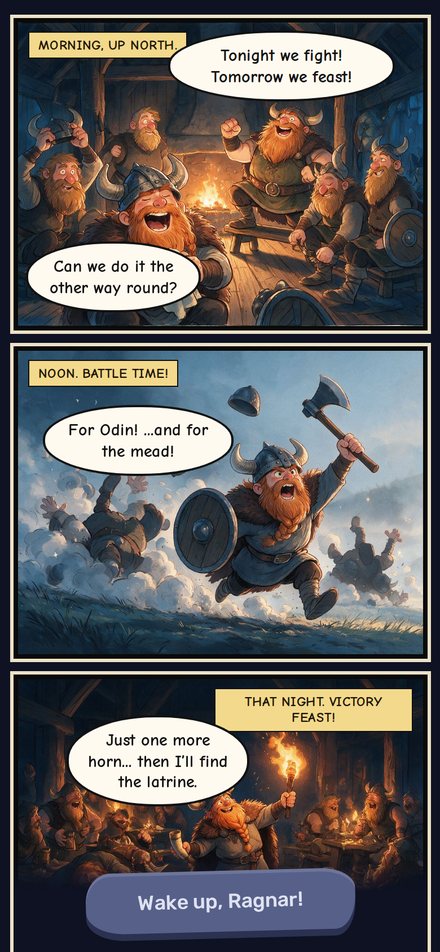
What I decided. A four-panel comic played as a short film: a battle, a victory feast, one more horn of mead, and Ragnar waking up in the maze. The skip button is visible the whole time.

The intro comic: morning up north, the battle and the victory feast

08

Iteration

Atmosphere, not noise

The idea. Rats, beetles and bats to make the maze feel alive. Harmless, only there for mood.

What went wrong. In the first version they crossed the player about every four seconds. Atmosphere turned into noise and pulled attention from the maze.

What I changed. Now they flee from the light and slowly drift away when they are far from Ragnar.

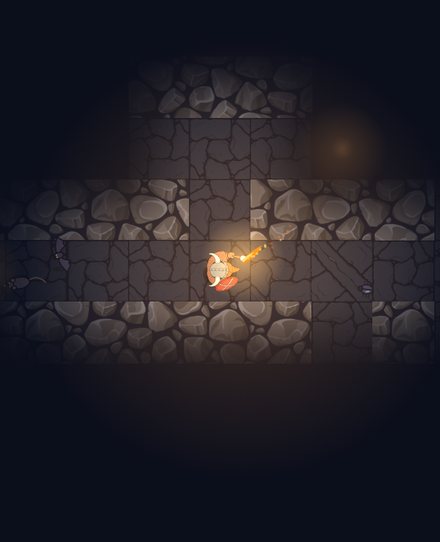
A rat, a bat and a beetle startled at the edge of the torchlight

09

Rating

Rewarding the right thing

The question. A run takes about a minute. What should the result measure, so that it pushes players towards the way the game is meant to be played?

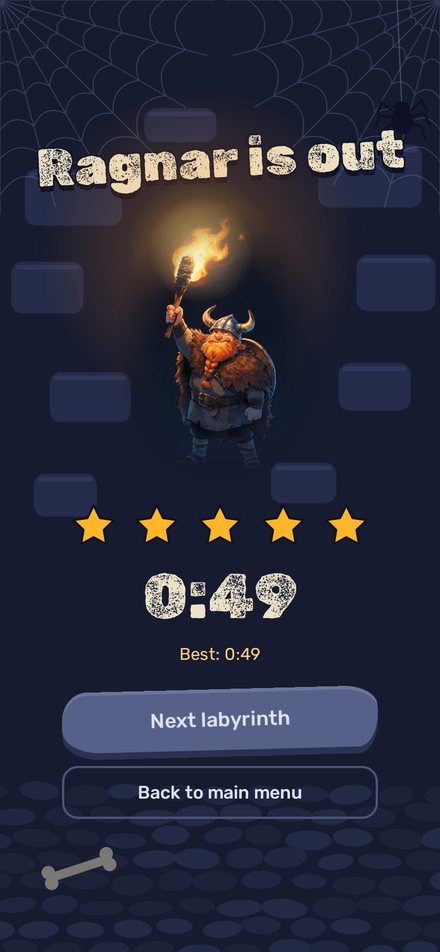
What I decided. Stars compare your time with the ideal run of each map, the shortest route from start to key, gate and stairs. Get close to it and you earn five stars. The slower you are, the fewer you get, but finishing always earns at least one. Your best time for each map is saved and shown under the result, so there is always a reason for one more try.

StarsYour time compared with the ideal run
★★★★★Time: up to 1.2×
★★★★Time: up to 1.5×
★★★Time: up to 2×
★★Time: up to 3×
★Time: you made it out

Why time, not flame. Counting the flame left at the end would teach players to hoard light and avoid every risk, which is the opposite of what the game is about. Counting time rewards confident exploring and quick decisions at every web and every crossing.

Ragnar is out: five stars for 0:49

10

Iteration

The last free slot

The idea. The inventory had a free fourth slot. I wanted a one-use emergency guide, hidden in a dead end, that shows the way to the exit, never to the key. Using it before you have the key is your own problem.

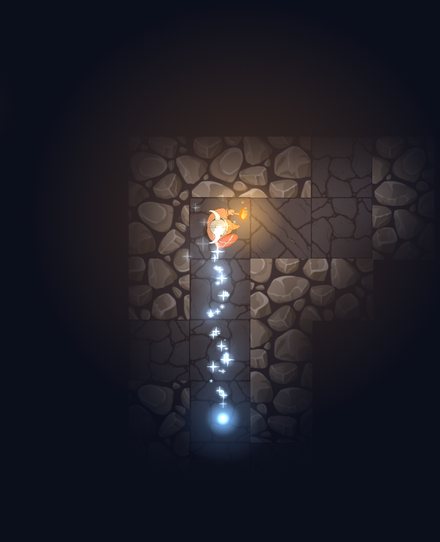
How it changed. The first idea was a raven. It became a Raidho rune stone that releases a blue light orb. The orb races ahead faster than you can follow, leaves a fading trail of sparks and flashes red when it passes a draugr. Ragnar's line when he picks it up depends on whether he already has the key.

The rune orb racing ahead with a trail of blue sparks

11

Art direction

Look and sound

The question. How do you get one consistent world out of tools that each generate something slightly different?

What I decided. A flat vector style for Ragnar, the draugr, items and tiles, then clean-up by hand: backgrounds removed, everything recoloured to one palette, the flame redrawn in code so it can react to the light. For music I chose a darker Nordic track that doesn't loop the same motif. Sound can be turned off on the first screen and the game remembers it.

The Dark Maze title screen with Ragnar holding his torch

Who did what

Along the way we kept a full written specification of every rule, number and edge case. It is the memory of the project, and this case study is built from it.

Me

  • The original idea, the character and the world
  • Connecting light, time and life into one mechanic
  • Every rule, every number and how they balance
  • Art direction, prompts and picking from many generations
  • Clean-up: backgrounds, one palette, the flame in code
  • Playing every version on a real phone and deciding what stays
  • The story, its humour and the tone of Ragnar's lines

AI

  • Claude wrote the game code, the test bot and kept the specification up to date
  • Recraft Vector in Magnific: Ragnar, the draugr, items and floor tiles
  • Kling 3.0 Turbo: the comic film and the looping title animation
  • ElevenLabs Music: a 2:30 Nordic ritual track
  • ElevenLabs sound effects: torch crackle and footsteps

The whole game ships as a single HTML file of about 2.3 MB. Generating every asset cost roughly 4,950 Magnific credits.

What this project shows

Seeing the system

The sketch had a torch. Making it the light, the timer and the life bar at once is what tied every other rule together. Most of the game grew from that one connection.

Moving forward in small steps

Nothing was designed upfront. Every rule was built, played and kept, changed or thrown away. The creatures and the rune stone only got good on the second or third try.

One idea leads to the next

No map made the maze tense. Tension made being lost a problem. Being lost led to the flame, and the flame led to the rune stone. Following those threads is how a single screen became a game.

AI as a team, not an author

With AI one designer could ship code, art, film and music. The speed made it possible to try more ideas, but knowing which ones are worth keeping was still the whole job.

How it was built, phase by phase

The iterations above didn't happen all at once. The game grew in four phases, each one playable before the next began.

  1. Phase 1

    The first idea

    Ragnar, his torch and one basic level. The light as the clock, one-thumb controls and darkness that forgets.

  2. Phase 2

    Challenge

    The draugr and the sword, spider webs, more levels and difficulty balanced so every map stays fair.

  3. Phase 3

    Life

    Animations, music and sound, and the small creatures scurrying around at the edge of the light.

  4. Phase 4

    A new element

    The rune stone: a one-use guide hidden in a dead end, filling the last free slot in the inventory.

Now find the way out

Three mazes, one torch each. About a minute, best on a phone, sound can be turned off on the first screen.

Play full screen

Coming next: more levels, a level editor and a shared leaderboard.

Back to case studies

Got a product problem?
Let’s look at it together.

branislav.bajbar@gmail.com +421 904 377 212 LinkedIn Download CV